


Ford Ranger 2.0 TDCi EcoBlue Bi-Turbo: improved performance for heavy-duty use.
In this Case History, we analyse an intervention carried out on a 205 hp Ford Ranger 2.0 TDCi EcoBlue Bi-Turbo, with the aim of increasing power and torque while optimising the power delivery curve for off-road use, even under full load.
Thanks to ECM Titanium software, it was possible to manage the modification, increasing both torque and power and achieving a result better suited to the vehicle’s use.
The first step was to measure power and torque in the original configuration, in order to obtain a concrete reference to compare with the results after the modification and demonstrate the effectiveness of the work carried out to the customer.
How? Simple, with DynoDrive, the on-road power test integrated into KESS3. The result was approximately 201 hp and 488 Nm of torque.
The actual calibration work was then carried out: the entire result was achieved by working exclusively on the calibration and on the main strategies managing torque, fuel, boost pressure and rail pressure.
Technical Specifications
- ECU: Continental SID213
- Type: Diesel engine, 4-cylinder Bi-Turbo
- Displacement: 1996 cm³
- Power: 205 hp (151 kW)
- Torque: 488 Nm
What modifications were made?
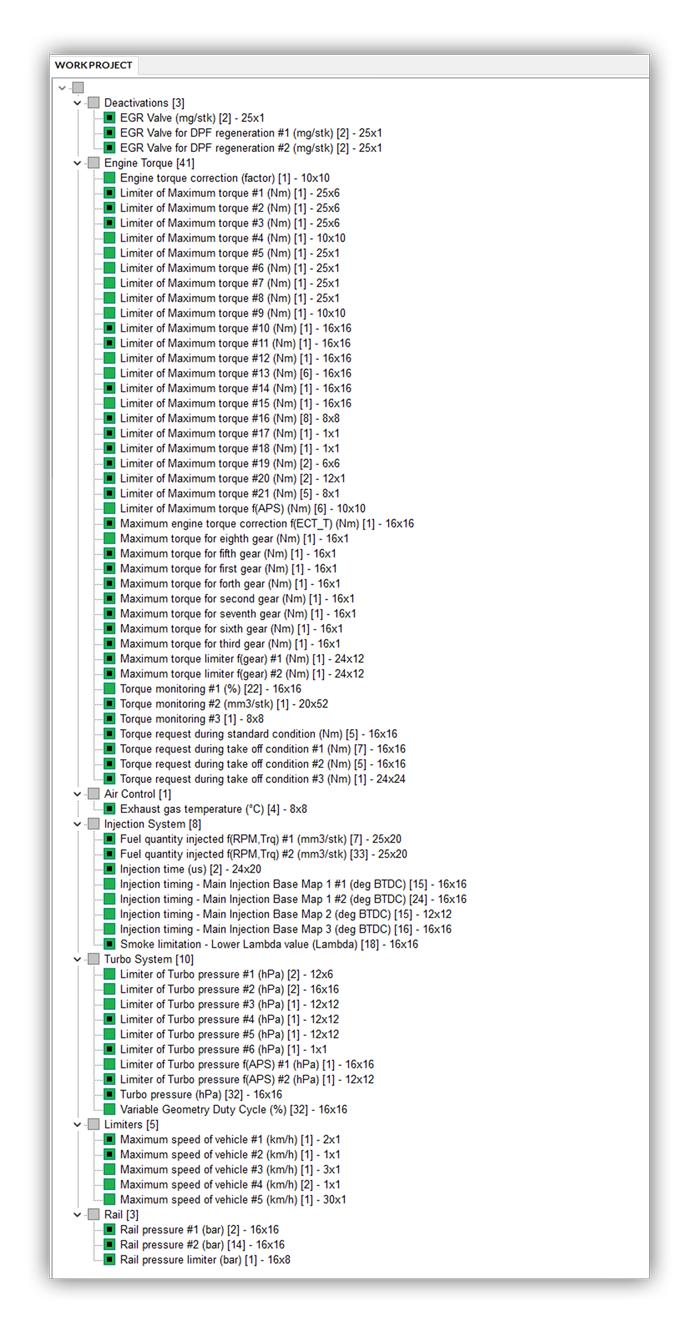
All the work was made possible by ECM Titanium software, thanks to dedicated Drivers that make it possible to isolate the relevant maps.
The first step focused on the torque limiters, bringing the maximum value close to the target defined for the vehicle.
Work was then carried out on fuel management, increasing:
- injection times
- IQ table values
All this was done to support the increased torque and power demand.
At this stage, it is important to coordinate the amount of injected fuel with the available air and smoke control strategies. The control performed through the lambda sensors prevents the AFR from dropping below a certain threshold, consequently limiting the possibility of further increasing the amount of injected fuel.
Once this first step had been completed, work was carried out on the following maps:
- boost pressure
- rail pressure
to provide the correct support for the increased amount of fuel introduced and the higher torque demand.
This intervention made it possible not only to increase the maximum power and torque values, but also to extend the power delivery curve, making the engine stronger and more usable across a wider operating range.
In the final step, work was carried out on the speed limiter, which is factory-set at 180 km/h.
To validate the work carried out and compare performance before and after the modification, a new on-road power test with DynoDrive proved useful.
Results obtained?
- Measured power: from 201 hp → 241 hp
- Measured torque: from 488 Nm → 601 Nm
- Power delivery: reshaped torque and power curve
The result is a higher-performing Ford Ranger with more responsive power delivery, achieving a significant increase in torque and power exclusively through ECU recalibration.
The intervention made it possible to make greater use of the potential of the 2.0 EcoBlue Bi-Turbo, extending the power delivery curve while keeping the development entirely focused on electronic engine management.
After the operation, the customer says:
“Now the Ranger has much more pulling power, especially when torque is needed at low and mid-range rpm. Under full load and in off-road use, you can feel the difference immediately: the engine is more responsive, stronger and maintains its power delivery better. It was exactly the result I was looking for, without having to make any mechanical modifications.”
Contact Us
Find out more